Emotions are not good or bad. They are signals. Your body and mind receiving and processing information about the world, and telling you something about it. The problem is most of us were taught to sort them into two piles: the ones that are acceptable, and the ones that need to be managed, suppressed, or apologised for. That sorting is the source of a lot of unnecessary suffering.
How many emotions are there?
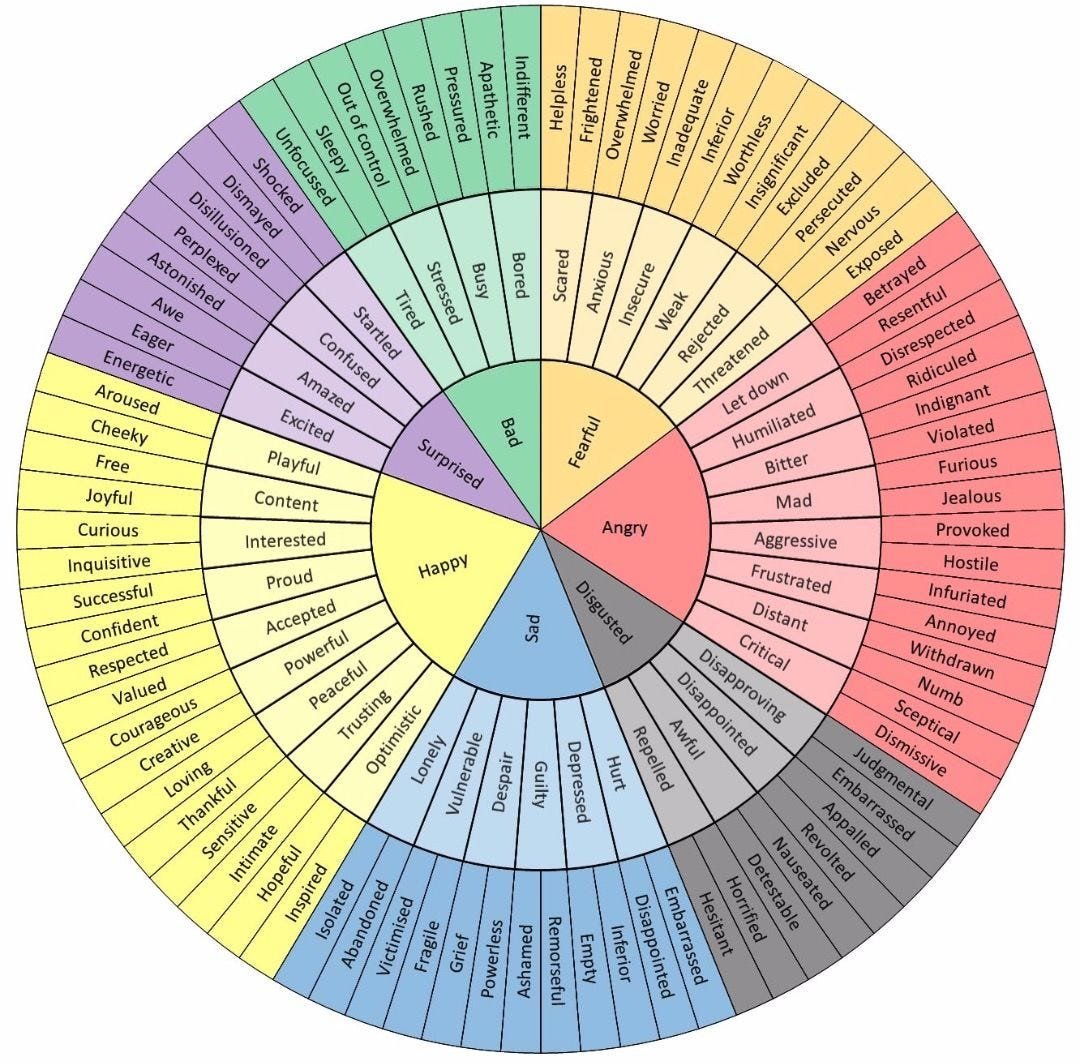
The short answer is: more than most of us have words for. Research from the Greater Good Science Center at UC Berkeley identified 27 distinct emotion categories, far beyond the basic six (happiness, sadness, fear, anger, disgust, surprise) that dominated psychological models for decades. Other frameworks go further. The emotion wheel shown below maps dozens of specific emotional states, organised by family and intensity.
Why does this matter? Because the more precisely you can name what you are feeling, the more effectively you can respond to it. There is a significant difference between feeling "bad" and feeling "humiliated." Between feeling "good" and feeling "grateful." The specificity is not pedantic. It changes what you do next.
The emotion wheel
The emotion wheel is a tool for navigating emotional vocabulary. At the centre are six core emotional families: happy, sad, fearful, angry, disgusted, surprised. Moving outward, each family branches into more specific emotional states, and then into even finer distinctions at the outer ring.
Use it when you know something feels off but you cannot put your finger on what. Start at the centre, find the family that feels closest, and work outward until a word lands. That moment of recognition, when the right word clicks, is not just linguistic. It is neurological. Something settles.
Emotions are like weather
One of the most useful reframes I have found is thinking about emotions the way we think about weather. Weather comes and goes. A storm does not mean the sky is broken. A grey day does not mean the sun no longer exists. We do not judge the weather as good or bad in a moral sense: we just notice it, prepare for it, and know it will change.
Emotions work the same way. They arise, they move through, they pass. Even the most intense emotional states are temporary if you do not actively hold onto them or suppress them. The problem is that most of us were never taught to let emotions move. We were taught to perform the acceptable ones and hide the rest. And suppressed weather does not just go away. It accumulates.
There are no bad emotions
Every emotion on that wheel exists for a reason. Every single one of them is information. The question is never whether the emotion is appropriate. The question is what it is telling you, and what, if anything, needs to happen next.
Sadness tells you something matters, or has been lost. Fear tells you something feels threatening and your body wants to protect you. Disgust tells you something feels wrong or violating. Surprise tells you your expectations and reality have diverged. And anger, the one most consistently labelled as bad or dangerous, tells you something important too.
On anger specifically
Anger has a reputation problem. It gets labelled as destructive, inappropriate, something to manage or apologise for. But anger is often the most correct emotion for a situation. It is the emotion that arises when a boundary has been crossed, when you have been treated unjustly, when something important to you has been disregarded or damaged. That is not dysfunction. That is your system working exactly as it should.
The problem is not anger itself. It is what we do with it. Anger expressed destructively or disproportionately causes harm. But anger that is suppressed, dismissed, or endlessly managed without ever being acknowledged also causes harm, just more slowly and more quietly. The goal is not to eliminate anger. It is to be able to feel it, name it accurately, understand what it is pointing at, and choose a response rather than simply reacting or swallowing it.
In concussion recovery, where emotional dysregulation is a direct neurological consequence of the injury, anger can feel frightening precisely because it seems to arrive faster and more intensely than before. Understanding that this is a brain-based change, not a character change, is important. The brain's emotional regulation systems are disrupted. The anger is real and often appropriate. The threshold is just lower.
Why emotional literacy matters in recovery
Naming emotions activates the prefrontal cortex and reduces activity in the amygdala. This is the same mechanism described in the journaling article: affect labelling, putting a feeling into words, creates a small but meaningful shift from being overwhelmed by an emotion to having a relationship with it.
In concussion recovery, where the emotional regulation systems of the brain are under strain, developing this skill is not a nice-to-have. It is practical support for an overloaded system. The more fluent you become at identifying what you are actually feeling, the less those feelings pile up unprocessed, and the less they tend to emerge sideways as irritability, withdrawal, or anxiety.
It also helps enormously in relationships. Being able to say "I am feeling humiliated right now" rather than "you always make me feel bad" changes the conversation completely. The precision is not just for you. It is for everyone around you.
I use the emotion wheel all the time. It sits in my journal kit alongside everything else, and I reach for it whenever I know something is going on but I cannot quite name it. That moment of finding the right word is consistently clarifying in a way that surprises me even now.
The reframe that has made the most difference to me is understanding emotions as signals rather than states. I spent a lot of years treating my emotional experience as something to manage, perform, or overcome. Particularly the ones I had been taught were problematic: anger, jealousy, fear. The work of learning to ask "what is this telling me?" instead of "how do I make this stop?" has been significant.
On anger: I had a complicated relationship with it for a long time. I had absorbed the idea, as a lot of women do, that anger was not an attractive or appropriate thing to express. So I found other ways to carry it. Until I started understanding it as information. Sometimes I am angry because something is genuinely wrong. Sometimes a boundary has been crossed, something I care about has been disregarded, or I am watching an injustice I cannot fix. Those are correct reasons to be angry. The anger is not the problem. It is the messenger.
Post-concussion, my emotional regulation was noticeably different. The threshold was lower, the intensity was higher, and I felt less able to pause between the feeling and the response. Understanding that this was neurological rather than a character flaw helped me extend compassion to myself during those years rather than shame. And gradually, as the brain healed and I built better emotional vocabulary and practices, the regulation came back.
Emotions, like weather, pass. Even the hard ones. Even the ones that feel like they will never lift. I have lived through enough of them now to know that is true.